Introduction
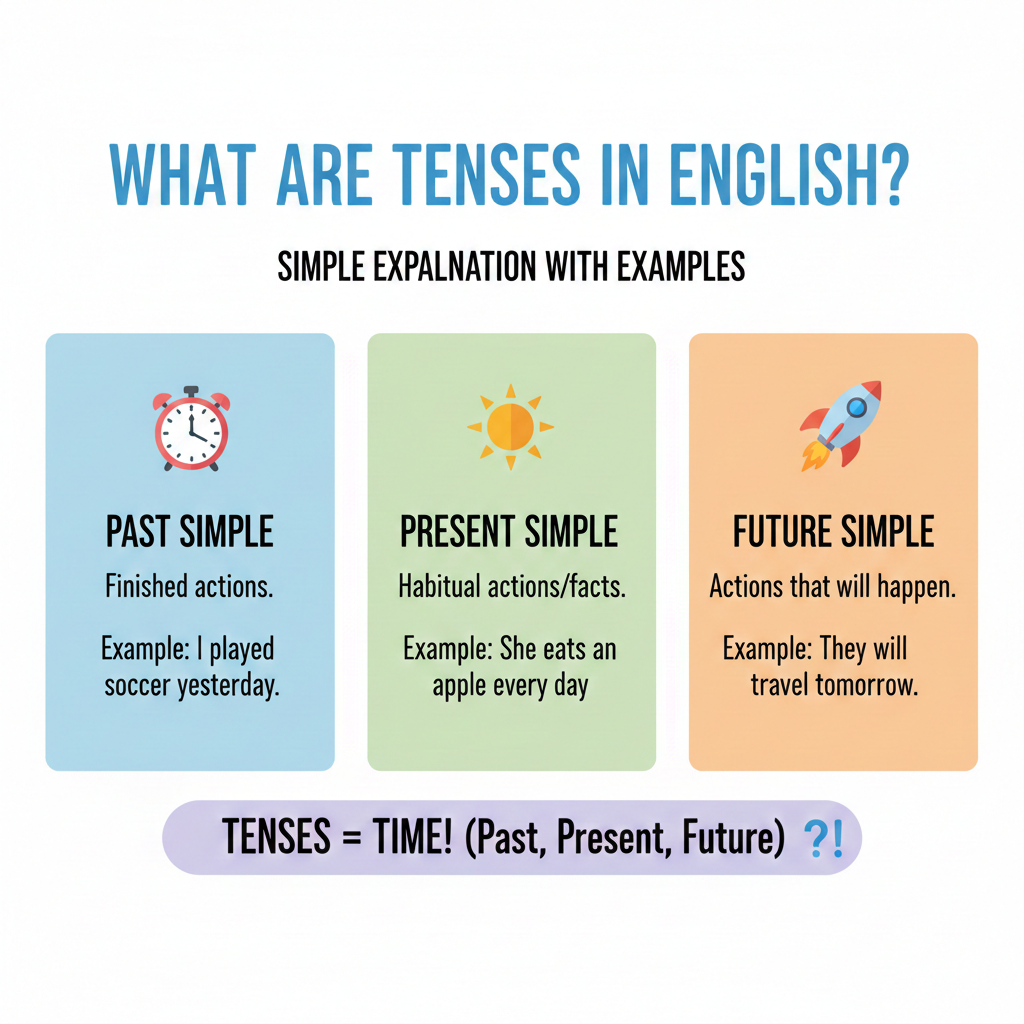
Tenses in English show when an action happens—in the past, present, or future. Understanding tenses helps students speak clearly, write correctly, and avoid confusing grammar mistakes.
Many learners feel overwhelmed by tenses because they try to memorize long tables without understanding the logic behind them. This leads to confusion during exams and incorrect sentence formation. In this article, you’ll learn what tenses really are, how they work in everyday English, and how to use them confidently with simple examples. The focus is on clarity and usage, not memorization.
Why Tenses Are Important in English
Tenses help the listener or reader understand time and meaning.
Without correct tense usage:
Sentences become unclear
Meaning changes unintentionally
Writing sounds unnatural
Exam answers lose marks
From real classroom experience, students who understand tenses conceptually make far fewer mistakes than those who memorize rules.
[Expert Warning]
Memorizing tense tables without understanding time context leads to repeated grammar errors.
What Are Tenses?
A tense tells us when an action takes place.
Basic Time Categories
Past → something already happened
Present → something happening now or regularly
Future → something that will happen
Example:
I studied yesterday. (Past)
I study every day. (Present)
I will study tomorrow. (Future)
Understanding this timeline is the foundation of all tenses.

The Three Main Tenses in English
Present Tense
Used for:
Daily habits
General truths
Actions happening now
Examples:
She reads books.
They are playing outside.
Past Tense
Used for:
Completed actions
Events in the past
Examples:
He finished his work.
We watched a movie.
Future Tense
Used for:
Actions that will happen
Plans and predictions
Examples:
I will call you.
They are going to travel.
Types of Tenses
English has 12 main tenses, grouped under past, present, and future.
| Time | Simple | Continuous | Perfect | Perfect Continuous |
| Present | I eat | I am eating | I have eaten | I have been eating |
| Past | I ate | I was eating | I had eaten | I had been eating |
| Future | I will eat | I will be eating | I will have eaten | I will have been eating |
[Pro-Tip]
You don’t need to master all 12 tenses at once. Start with simple and continuous forms first.

How to Choose the Correct Tense
Ask yourself three questions:
When did the action happen?
Is it completed or ongoing?
Is the time clear or connected to the present?
Answering these automatically guides tense choice.
Common Tense Mistakes Students Make
| Mistake | Why It Happens | Correct Approach |
| Mixing tenses in one sentence | Lack of timeline | Keep time consistent |
| Overusing present continuous | Confusion | Use simple present for habits |
| Wrong use of “has/have” | Rule memorization | Focus on meaning |
| Using future for fixed plans | Translation habit | Use present tense |
Information Gain: Why Tenses Feel Hard
Most SERP pages teach tenses as formulas.
The Missing Insight
Tenses are not rules—they are time signals.
When students imagine a timeline instead of memorizing verb forms, tense selection becomes natural and intuitive. This approach is rarely emphasized but dramatically improves accuracy.
UNIQUE SECTION — Beginner Mistake Most People Make
Mistake: Trying to learn all 12 tenses together
In real learning situations, students progress faster when they master:
Present simple
Past simple
Future simple
Only after this should they move to perfect and continuous forms.
[Money-Saving Recommendation]
Skip expensive grammar charts initially—practice tense usage through simple daily sentences instead.
How to Practice Tenses in English Effectively
Write 5 sentences daily (past, present, future)
Change time words (yesterday, today, tomorrow)
Speak sentences aloud
Correct mistakes immediately
Consistent practice matters more than theory.
Internal Linking Plan
Anchor: parts of speech explained
Anchor: active and passive voice rules
Anchor: common grammar mistakes
FAQ
Q1. How many tenses are there in English?
There are 12 main tenses in English.
Q2. Are tenses difficult to learn?
No, they are easy when understood conceptually.
Q3. Which tense should beginners learn first?
Present simple tense.
Q4. Why do students confuse tenses?
Because they memorize rules instead of understanding time.
Q5. Can I speak English without perfect tense knowledge?
Yes, basic tenses are enough for communication.
Conclusion
Tenses are simply a way to express time in English. When students stop memorizing rules and start understanding timelines, tense usage becomes clear and natural. By practicing simple examples regularly and focusing on meaning, learners can master English tenses without confusion or stress.