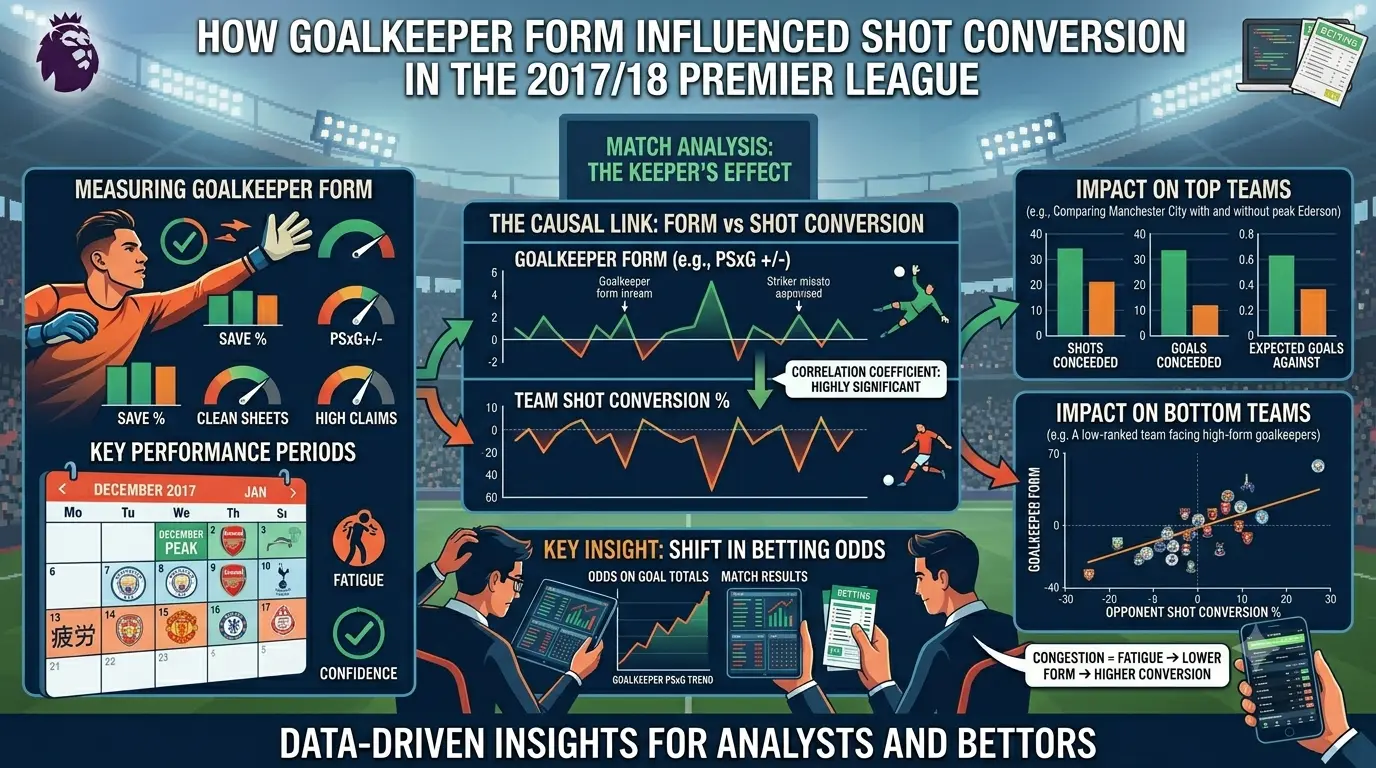
During the 2017/2018 Premier League season, goalkeeper performance played a decisive role in determining whether shots resulted in goals. While attacking metrics often dominate analysis, the variation in goalkeeping quality created measurable differences in shot conversion rates across matches. Understanding this relationship reveals why similar chances can produce very different outcomes.
Why Goalkeeper Form Alters Expected Outcomes
Shot conversion is not solely dictated by chance quality. Goalkeeper positioning, reaction time, and decision-making directly influence whether a shot becomes a goal.
When a goalkeeper is in strong form, even high-quality chances may be saved, reducing actual goals below expected levels. Conversely, poor form increases the likelihood that routine shots result in goals, inflating scoring beyond statistical expectations.
This dynamic introduces variability that standard attacking metrics cannot fully capture.
Identifying Goalkeepers Who Shifted Match Outcomes
Certain goalkeepers during the 2017/2018 season consistently influenced results through their performance levels.
- David de Gea: Exceptional shot-stopping that reduced opponent conversion rates.
- Nick Pope: Strong reflexes and positioning despite high defensive pressure.
- Kasper Schmeichel: Reliable in one-on-one situations.
- Joe Hart: Inconsistent form leading to higher-than-expected goals conceded.
These examples illustrate how individual performance can override team-level defensive metrics.
The implication is clear: evaluating teams without considering goalkeeper form leads to incomplete analysis, particularly in matches with balanced chance creation.
Mechanisms That Affect Save Probability
Goalkeeper effectiveness is shaped by multiple interacting factors that determine how likely a shot is to be saved.
Core performance elements
- Positioning relative to shot angle reduces available scoring space.
- Reaction speed determines response to close-range attempts.
- Handling ability prevents second-chance opportunities.
- Decision-making influences whether to stay, rush, or anticipate.
These elements operate together. For instance, strong positioning reduces the need for extreme reflex saves, while poor positioning increases reliance on reaction speed.
Understanding these mechanisms clarifies why some goalkeepers consistently outperform others under similar conditions.
How Goalkeeper Form Impacts Betting Interpretation
Goalkeeper performance often creates discrepancies between expected and actual outcomes. When analyzing matches, bettors who account for this factor can better interpret scoring probabilities.
Under certain conditions, when evaluating odds through a sports betting service such as ufabet168, matches involving high-performing goalkeepers may appear overpriced in goal markets. This occurs because public perception tends to focus on attacking strength while underestimating defensive resistance at the individual level.
When Goalkeeper Influence Breaks Down
Despite strong form, goalkeepers cannot control every variable. Certain conditions reduce their impact on shot outcomes.
- Defensive breakdowns create uncontested chances.
- Deflections alter shot trajectories unpredictably.
- High shot volume increases cumulative pressure.
These situations highlight the limits of individual influence. Even elite goalkeepers struggle when exposed to repeated high-quality chances.
Comparing High vs Low Conversion Environments
Different combinations of attacking quality and goalkeeper form produce distinct scoring environments.
Scenario | Characteristics | Outcome
Strong attack + strong goalkeeper | High-quality chances, frequent saves | Moderate scoring
Weak attack + weak goalkeeper | Low-quality chances, poor saves | Unpredictable scoring
Strong attack + weak goalkeeper | High-quality chances, poor resistance | High scoring
This comparison shows that goal output depends on interaction rather than isolated factors. A strong attack does not guarantee goals if opposed by elite goalkeeping.
Market Behavior and Hidden Variables
Market pricing often reflects team-level metrics more than individual performance. Within a casino online context, where football betting is integrated into a broader system, goalkeeper-specific analysis may not be fully incorporated into odds adjustments. This creates situations where shot conversion probabilities differ from market expectations.
Integrating Goalkeeper Analysis With Data Models
To improve predictive accuracy, goalkeeper performance should be combined with metrics such as expected goals and shot location data. This integration provides a more complete view of scoring probability.
For example, a team generating high xG against a top-performing goalkeeper may still struggle to convert chances. Without incorporating this factor, models may overestimate goal output.
Limits of Relying on Goalkeeper Form Alone
While influential, goalkeeper form is not stable over long periods. Performance can fluctuate due to fatigue, confidence, or tactical changes.
- Short-term form may not persist across multiple matches.
- External factors such as injuries affect consistency.
- Variance in shot difficulty impacts perceived performance.
These limitations mean that goalkeeper analysis should complement, not replace, broader evaluation.
Behavioral Interpretation During Matches
In live situations, goalkeeper performance can shift momentum. A series of saves may reduce attacking confidence, while an early mistake can increase pressure on the defense.
This psychological effect influences both teams, altering shot selection and risk-taking behavior. Recognizing these shifts provides additional context beyond raw statistics.
Summary
Goalkeeper form during the 2017/2018 Premier League season significantly influenced whether shots resulted in goals. By understanding how individual performance interacts with chance quality, bettors can better interpret scoring probabilities and identify discrepancies between expectation and outcome.