
Introduction
Common grammar mistakes happen when students focus on memorizing rules instead of understanding how English works in real sentences. Identifying these mistakes and fixing them early improves accuracy in exams, writing, and daily communication.
Many learners repeat the same grammar errors for years because no one clearly explains why the mistake happens. As a result, even well-prepared students lose marks in exams and feel unsure while writing. This article breaks down the most common grammar mistakes students make, explains the reason behind each error, and shows how to correct them with simple, practical methods.
Why Grammar Mistakes Keep Repeating
From real classroom and exam experience, grammar mistakes usually repeat for three reasons:
Learning rules without examples
Translating directly from the native language
Practicing without feedback
[Expert Warning]
Repeating grammar exercises without understanding mistakes only strengthens bad habits.
Mistake #1: Confusing Adjectives and Adverbs
The Problem
Students often use adjectives instead of adverbs (or vice versa).
Incorrect:
She sings beautiful.
Correct:
She sings beautifully.
Why It Happens
Students focus on meaning, not function.
Fix
Ask: Is this word describing a noun or an action?
Mistake #2: Incorrect Subject–Verb Agreement
The Problem
The verb does not match the subject.
Incorrect:
She go to school.
Correct:
She goes to school.
Why It Happens
Ignoring singular and plural subjects.
Fix
Identify the real subject before choosing the verb.
Mistake #3: Wrong Use of Tenses
The Problem
Mixing tenses in one sentence or paragraph.
Incorrect:
Yesterday, I go to the market.
Correct:
Yesterday, I went to the market.
Fix
Match tense with time words (yesterday, now, tomorrow).
Mistake #4: Misuse of Prepositions
The Problem
Using the wrong preposition after certain words.
Incorrect:
He is good in math.
Correct:
He is good at math.
Why It Happens
Prepositions don’t follow strict rules.
Fix
Learn prepositions through sentence examples, not rules.
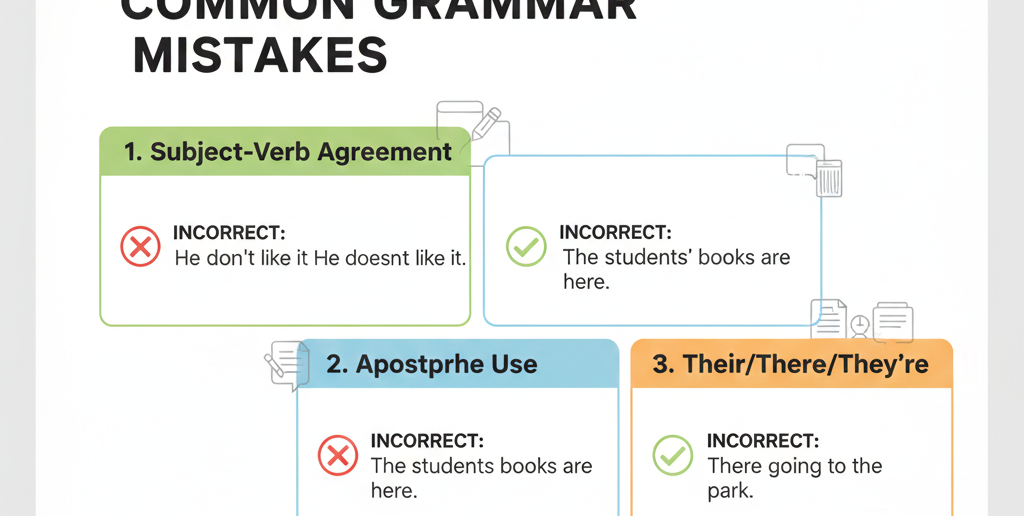
Common Grammar Mistakes at a Glance
| Mistake Area | Example (Wrong) | Example (Correct) |
| Adjective/Adverb | She runs quick | She runs quickly |
| Subject–Verb | They was late | They were late |
| Tense | I eat yesterday | I ate yesterday |
| Preposition | Interested on | Interested in |
Mistake #5: Overusing Passive Voice
The Problem
Using passive voice where active voice is clearer.
Weak:
The homework was done by me.
Better:
I did the homework.
Fix
Use passive voice only when the doer is unknown or unimportant.
Mistake #6: Sentence Fragments
The Problem
Incomplete sentences presented as full sentences.
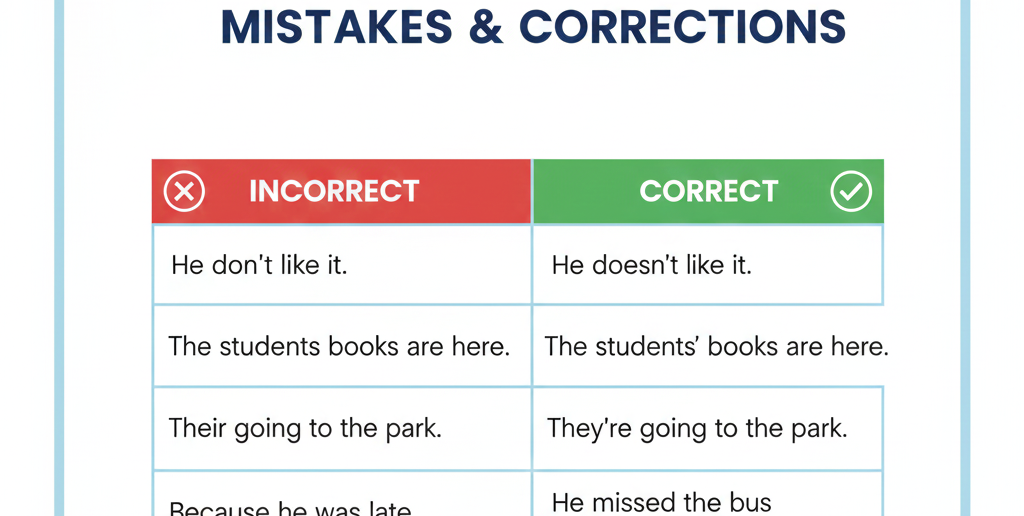
Incorrect:
Because he was late.
Correct:
He missed the class because he was late.
Fix
Check if the sentence has both a subject and a verb.
Information Gain: Why Students Know Rules But Still Make Mistakes
Most SERP articles list errors but don’t explain habit formation.
The Missing Insight
Grammar mistakes repeat because students practice recognition, not production.
Reading correct sentences is not enough. Writing and speaking from memory is what fixes errors permanently.
UNIQUE SECTION — Practical Insight From Experience
In real exam correction sessions, students who maintain a small “mistake notebook” improve faster than those who rewrite full notes. Writing only the mistake and its correction trains the brain to notice patterns.
[Money-Saving Recommendation]
Instead of buying grammar workbooks, correct your own writing daily—it delivers better long-term improvement.
How to Reduce Grammar Mistakes Permanently
Write short paragraphs daily
Read sentences aloud
Self-check for one mistake type at a time
Revise corrected errors weekly
Small daily corrections beat large grammar lessons.
Internal Linking Plan
Anchor: parts of speech explained
Anchor: what are tenses in English
Anchor: sentence types with examples
FAQ
Q1. Why do students make the same grammar mistakes repeatedly?
Because they memorize rules without practicing usage.
Q2. What is the most common grammar mistake?
Subject–verb agreement errors.
Q3. How can I reduce grammar mistakes quickly?
Practice writing and correct errors daily.
Q4. Is speaking English helpful for grammar improvement?
Yes, speaking reinforces correct sentence patterns.
Q5. Do grammar mistakes reduce exam marks?
Yes, especially in writing-based exams.
Conclusion
Grammar mistakes are not a sign of low ability—they are a sign of unclear understanding. When students focus on why mistakes happen and practice correcting them actively, grammar improves naturally. With consistent attention and simple correction habits, even long-standing errors can be fixed.


