Introduction
Parts of speech are the basic building blocks of English sentences that show how words function and relate to each other. Understanding them helps students write correctly, speak clearly, and avoid common grammar mistakes.
Many learners memorize definitions of parts of speech without truly understanding how they work in real sentences. This leads to confusion during exams and weak writing skills. This article explains parts of speech in a clear, practical way, using everyday examples instead of complex grammar terms. You’ll learn how each part functions, how to identify it easily, and how to avoid the mistakes students commonly make.
Why Parts of Speech Matter in English
Grammar is not about rules—it’s about meaning and structure.
Understanding parts of speech helps students:
Construct correct sentences
Understand exam questions better
Improve writing clarity
Avoid basic grammar errors
From real classroom experience, students who understand parts of speech struggle far less with tenses, voice, and sentence structure later on.
[Expert Warning]
Memorizing grammar rules without understanding parts of speech leads to repeated mistakes.
What Are Parts of Speech?
Parts of speech describe how a word is used in a sentence, not what the word means by itself.
For example:
The word “work” can be:
a noun → My work is important.
a verb → I work every day.
This flexibility is why understanding function matters more than memorization.
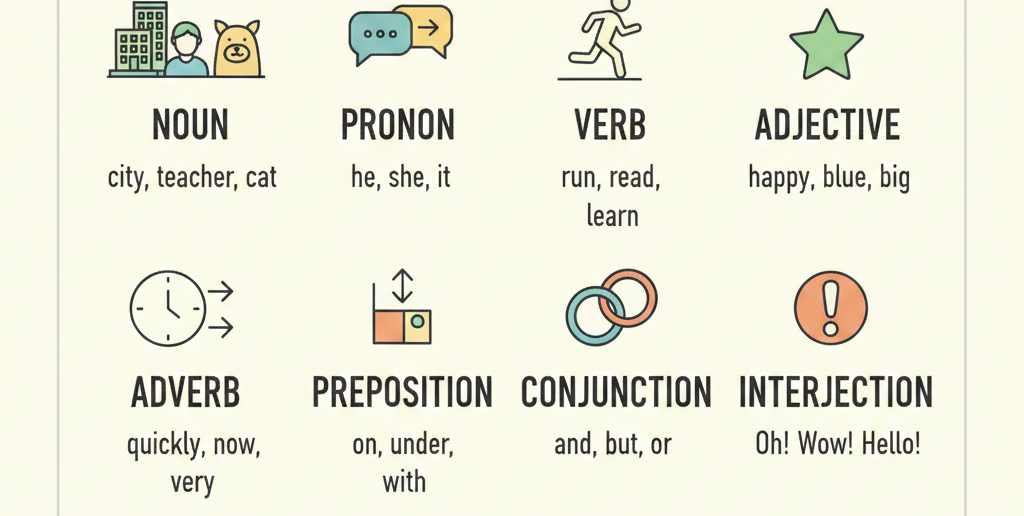
The 8 Main Parts of Speech in English
Noun – Names Something
A noun names a person, place, thing, or idea.
Examples:
Student
City
Book
Freedom
Sentence:
The student reads a book.
Pronoun – Replaces a Noun
A pronoun replaces a noun to avoid repetition.
Examples:
He, she, it
They, we
This, that
Sentence:
Sara is absent today. She is sick.
Verb – Shows Action or State
A verb tells what the subject does or what state it is in.
Examples:
Run
Think
Is, are, was
Sentence:
They are studying grammar.
Adjective – Describes a Noun
An adjective gives more information about a noun.
Examples:
Big
Happy
Difficult
Sentence:
She solved a difficult problem.
Adverb – Describes a Verb, Adjective, or Adverb
An adverb explains how, when, where, or to what extent.
Examples:
Quickly
Yesterday
Very
Sentence:
He answered very quickly.
Preposition – Shows Relationship
A preposition shows the relationship between a noun and another word.
Examples:
In
On
Under
Between
Sentence:
The book is on the table.
Conjunction – Joins Words or Sentences
A conjunction connects words, phrases, or clauses.
Examples:
And
But
Because
Sentence:
She studied hard because she wanted to pass.
Interjection – Expresses Emotion
An interjection shows sudden feeling or emotion.
Examples:
Oh!
Wow!
Alas!
Sentence:
Wow! You did a great job.
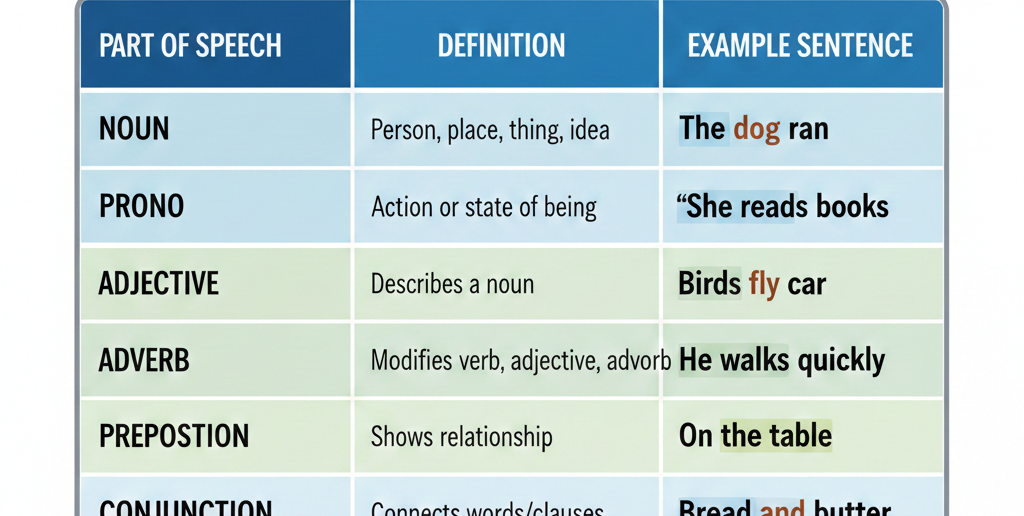
Parts of Speech at a Glance
| Part of Speech | Function | Example |
| Noun | Names something | Book |
| Pronoun | Replaces noun | She |
| Verb | Shows action/state | Run |
| Adjective | Describes noun | Smart |
| Adverb | Modifies action | Quickly |
| Preposition | Shows relation | On |
| Conjunction | Joins words | But |
| Interjection | Shows emotion | Wow |
Common Mistakes Students Make
| Mistake | Why It Happens | Correct Approach |
| Confusing adjective & adverb | Similar meaning | Check what is being described |
| Treating every “-ly” word as adverb | Overgeneralization | Check sentence role |
| Memorizing lists only | No context | Learn through sentences |
| Ignoring word function | Focus on meaning only | Focus on usage |
Information Gain: Why Definitions Alone Don’t Work
Most top-ranking pages list definitions without showing how words change roles.
The Missing Insight
A word’s part of speech depends on how it’s used, not the word itself.
Understanding this single concept solves:
Adjective/adverb confusion
Verb/noun confusion
Sentence correction questions
This is rarely explained clearly but makes grammar much easier.
UNIQUE SECTION — Practical Insight From Experience
In practical classroom situations, students improve fastest when they underline words in sentences and ask “what is this word doing here?” instead of asking “what is this word?”. This shift from meaning to function dramatically reduces grammar errors.
[Money-Saving Recommendation]
You don’t need expensive grammar books—practice identifying parts of speech in everyday sentences like news headlines or short stories.
How Parts of Speech Help in Exams & Writing
Sentence correction questions become easier
Error spotting improves accuracy
Writing becomes clearer and more natural
Spoken English sounds more confident
Grammar topics like tenses, voice, and clauses become simpler once parts of speech are clear.
Internal Linking Plan
Anchor: what are tenses in English
Anchor: sentence types with examples
Anchor: common grammar mistakes
FAQ
Q1. How many parts of speech are there in English?
There are eight main parts of speech in English.
Q2. Can a word belong to more than one part of speech?
Yes, depending on how it is used in a sentence.
Q3. Why are parts of speech important?
They help form correct sentences and improve writing and speaking.
Q4. Is memorizing parts of speech enough?
No, understanding usage in sentences is more important.
Q5. How can I identify parts of speech easily?
Ask what role the word is playing in the sentence.
Conclusion
Parts of speech form the foundation of English grammar. When students understand how words function inside sentences, grammar becomes logical instead of confusing. By focusing on usage rather than memorization, learners can improve writing, speaking, and exam performance with far less effort.